The 3-Minute Guide to Picking the Perfect Plastic Pallet
Published:
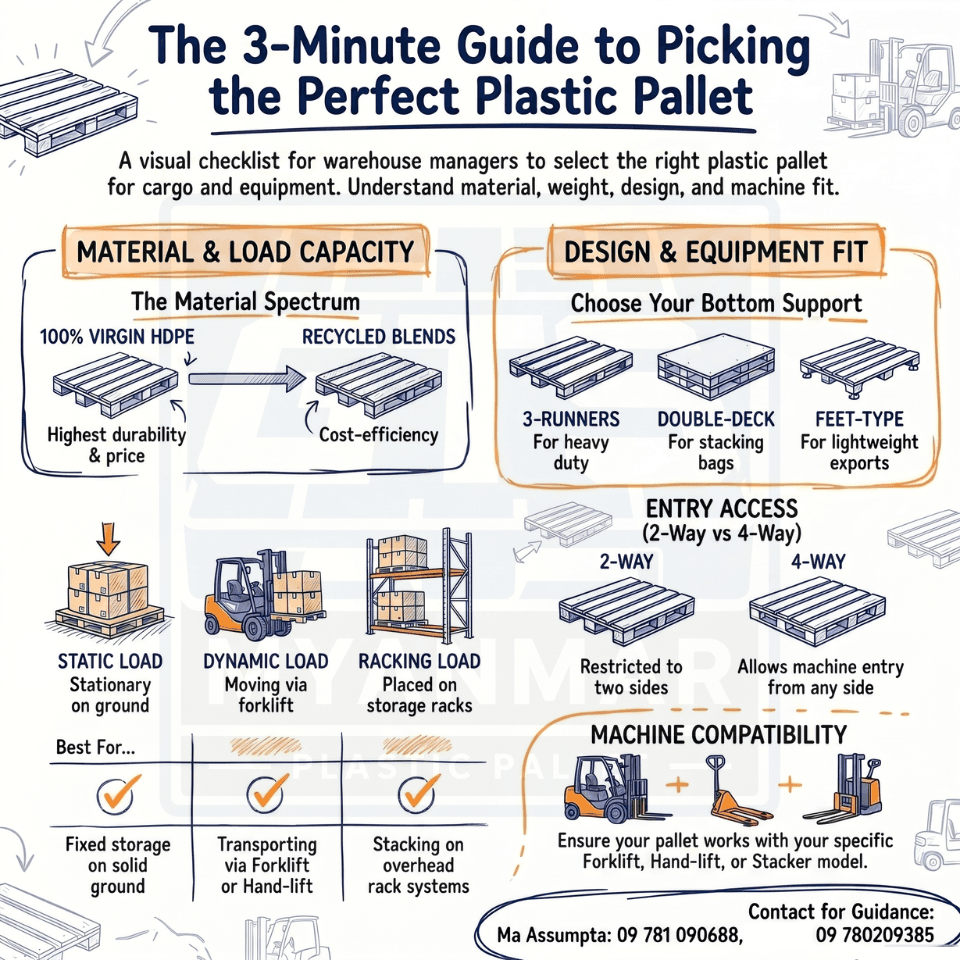
The 3-Minute Guide to Picking the Perfect Plastic Pallet
Before you invest in plastic pallets for your warehouse or logistics operation, there are six key specification areas you must understand. Getting these right ensures the pallet performs safely and cost-effectively for your specific cargo and equipment.
Size
Plastic pallets are specified with three dimensions: Width × Length × Height. Calculate your cargo footprint and stack height first, then match it against pallet dimensions. A pallet that is too small risks overhanging loads; one that is too large wastes floor and racking space.
Material
Two primary raw materials are used to manufacture plastic pallets: PP (Polypropylene) and HDPE (High-Density Polyethylene). However, manufacturers use many material grades in practice — PP, High-Grade PP, Recycled HDPE, Recycled HDPE + Virgin HDPE, and 100% Virgin HDPE. The most durable and highest-quality option is 100% Virgin HDPE, which also carries the highest price. Choose based on your duty cycle and budget.
Loading Capacity
Loading capacity is the maximum weight a pallet can safely bear. There are three capacity types you must know:
- Static Load — the maximum weight the pallet can hold when placed on solid, flat ground.
- Dynamic Load — the maximum weight it can handle while moving on a forklift or hand pallet truck.
- Racking Load — the maximum weight it can carry when placed on pallet racking (only relevant if you use a racking system).
Always check all three limits against your heaviest expected load.
Surface Type
Plastic pallets come in two surface options:
- Solid (closed deck) — best for small or granular cargo that could fall through gaps.
- Ventilated (open deck) — allows airflow and drainage, preferred for produce, chemicals, or hygiene-sensitive goods.
Choose based on the nature of your cargo.
Bottom Support
The base design of a pallet determines which equipment can use it and what loads it can bear. The four standard bottom support types are:
- 3-Runner type — designed for medium to heavy-duty applications; compatible with all forklift, hand truck, and stacker equipment; the most versatile choice.
- Double Deck type — both top and bottom surfaces are smooth, ideal for bagged goods (grain, cement, rice) that need to be stacked pallet-on-pallet.
- Cross / Window type — similar stacking capability to Double Deck but lighter duty; more affordable and suited to lighter cargo.
- Feet type (9, 18, or 36 feet) — designed for light-duty or export cargo; nestable for compact storage; the most economical option.
Equipment Compatibility
Three types of material-handling equipment are used with pallets: Forklifts, Hand Pallet Trucks (hand lifts), and Stackers. The pallet specification will indicate how many entry directions the equipment can use:
- 4-way entry — equipment can enter from any of the four sides.
- 2-way entry — equipment can only enter from two opposite sides.
- N/A — that equipment type is not compatible with this pallet.
Understanding these six areas takes only a few minutes but can save you costly mistakes when selecting plastic pallets for your operation.