6 Reasons Your Warehouse Needs a Pallet Upgrade
Published:
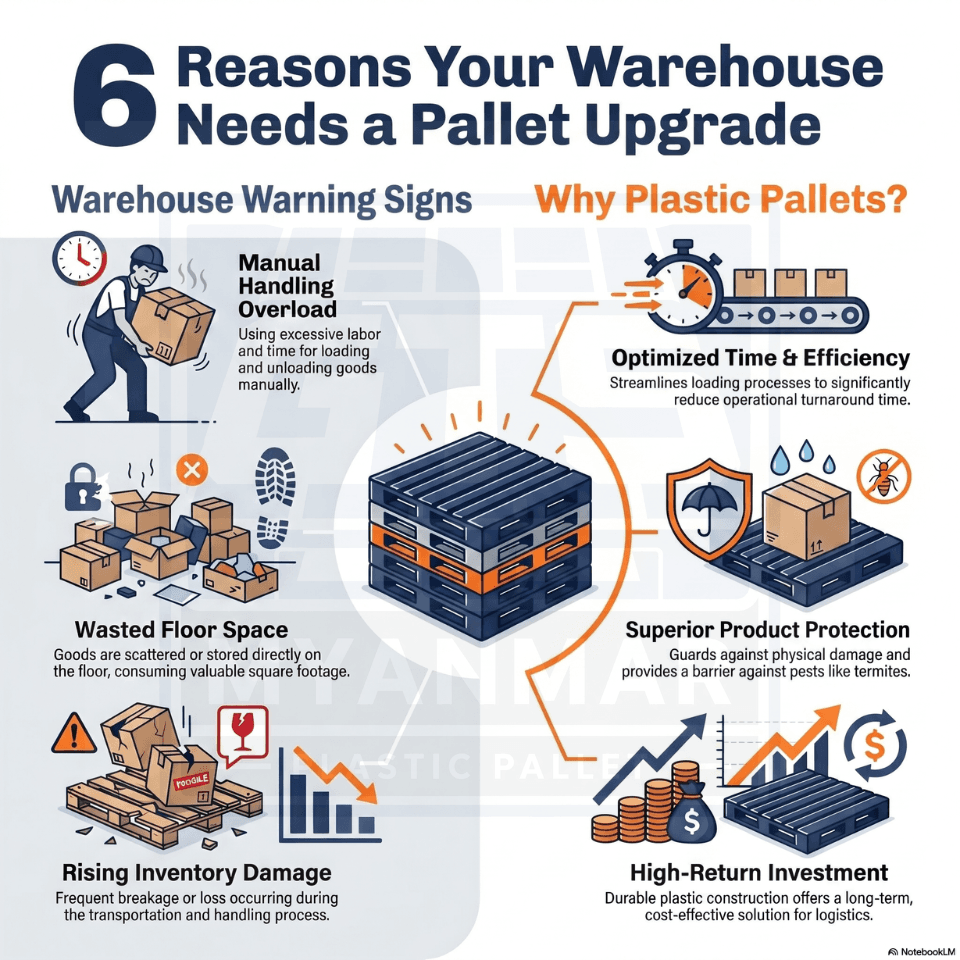
6 Reasons Your Warehouse Needs a Pallet Upgrade
Many warehouse operators in Myanmar still rely on manual processes or aging wooden pallets for cargo handling. The signs that you need a pallet upgrade are usually visible long before the cost becomes obvious. Here are six situations that indicate plastic pallets are the right solution for your operation.
Warning Signs Your Warehouse Needs Pallets
1. You Need Many Workers Just to Load and Unload
If your loading and unloading operations require a large number of staff because goods are being moved by hand, you are paying a recurring labor cost that pallets and basic equipment eliminate. A pallet-and-forklift workflow can replace 4–6 manual workers per shift for standard warehouse movements.
2. Your Goods Are Spread Across the Floor
When cargo sits directly on the floor in scattered piles, you lose usable floor area and make stock counting and rotation difficult. Pallets create defined, stackable storage units that reclaim floor space and enable proper FIFO rotation.
3. Damage Is Rising During Handling
Increased product damage during loading, transport, or unloading is a direct indicator that your handling system is not protecting your cargo. Pallets provide a stable, elevated platform that reduces contact damage and allows safe mechanical handling.
Why Plastic Pallets Are the Answer
4. Smoother, Faster Operations
Plastic pallets have consistent, uniform dimensions and smooth surfaces that move predictably through forklift, conveyor, and racking systems. This consistency reduces handling time and minimizes the jams and delays that irregular wooden pallets cause in automated or semi-automated environments.
5. Pest and Contamination Protection
Plastic pallets cannot harbor insects, termites, or rodents, and their non-porous surface does not absorb moisture, chemicals, or biological contaminants. This makes them essential for food storage, pharmaceutical handling, and any regulated logistics environment.
6. Long-Term Cost Efficiency
The higher upfront cost of plastic pallets is offset by their 3–10 year service life compared to 6–12 months for wooden pallets. For operations running pallets through multiple cycles per year, plastic delivers a lower total cost per trip and requires no repair or fumigation expenditure.
If your warehouse is experiencing any of these warning signs, switching to plastic pallets is one of the highest-return infrastructure decisions you can make.