Plastic vs. Wood: The Pallet Efficiency Guide
Published:
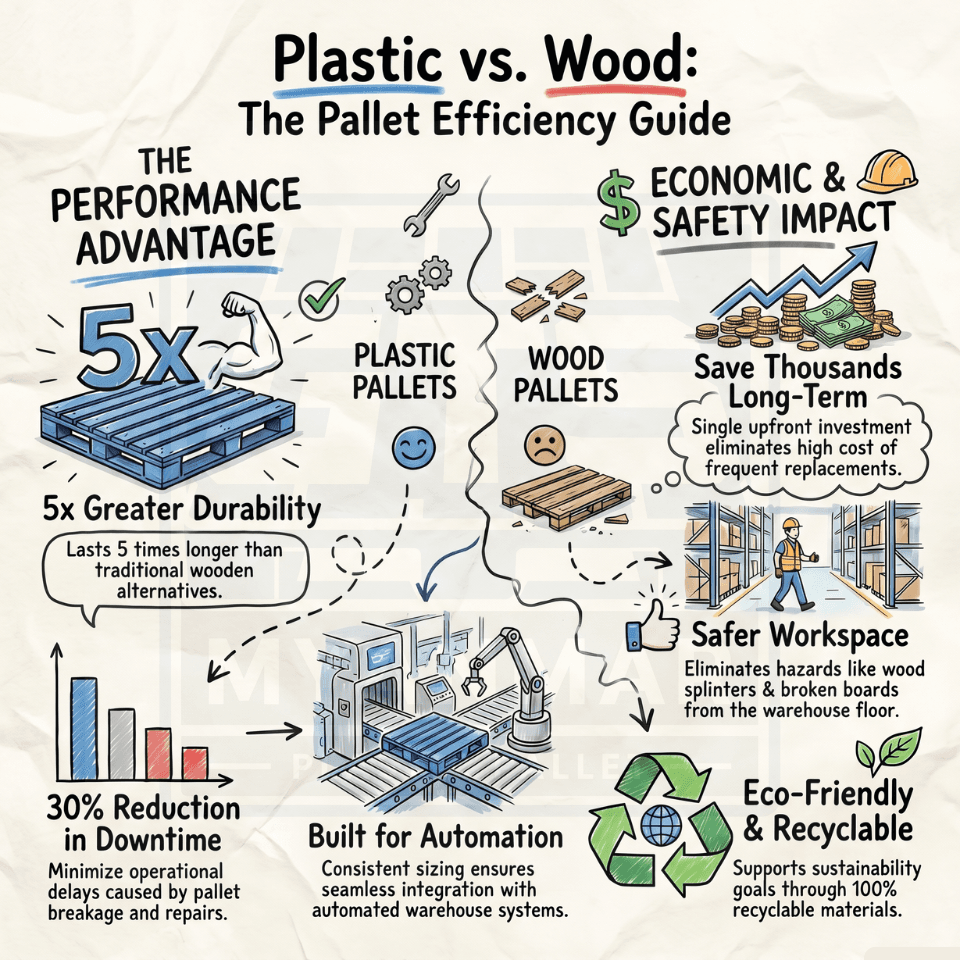
Plastic vs. Wood: The Pallet Efficiency Guide
The decision to switch from wooden to plastic pallets is ultimately a numbers question. This guide presents the efficiency case for plastic pallets across three dimensions: service life, operational consistency, and environmental footprint.
Service Life: Up to 5× Longer
Plastic pallets last 3 to 10 years under standard warehouse conditions. Wooden pallets typically need replacement every 6 to 12 months due to splitting, nail loosening, and moisture damage. Over a 5-year period, a wooden pallet will have been replaced 5 to 10 times while the plastic pallet is still in service.
The direct cost implication: even though a plastic pallet costs more to purchase, its total cost over a 5-year period is significantly lower when you account for the cumulative purchase price of the wooden pallets it replaces.
Reducing Downtime from Pallet Failures
Pallet failures — a broken board, a collapsed runner, a loose nail — interrupt warehouse operations in several ways:
- The load must be manually restacked onto a replacement pallet.
- Automated conveyor or racking systems may jam or be damaged by a failed pallet.
- Worker injuries from collapsing pallets require incident reporting and recovery time.
Studies and industry data consistently show that switching to plastic pallets reduces pallet-related downtime by 20–30%. For a high-throughput warehouse, this directly translates into more pallet movements per shift and lower labor cost per unit handled.
Consistent Dimensions for Automation Compatibility
Wooden pallets vary in dimension between manufacturers and batches. This dimensional inconsistency causes misalignment in conveyor systems, irregular stack heights in racking, and problems with automated picking equipment.
Plastic pallets are manufactured in precision molds with consistent, repeatable dimensions. Every pallet in a shipment will sit at the same height, present the same entry-point geometry to forklifts, and stack to a predictable height in racking. For any operation using automated or semi-automated material handling, this consistency is an operational requirement, not a preference.
No Splinters, No Loose Nails
Wooden pallets degrade progressively. Splinters and protruding nails create two categories of cost:
- Product damage — packaging snagged by splinters or punctured by nails.
- Worker injuries — hand and foot injuries requiring medical treatment and reporting.
Plastic pallets have no splinters, no nails, and no sharp edges. The smooth surface moves goods cleanly and eliminates the injury pathway entirely.
Environmental Consideration
At end of service life, plastic pallets can be returned to their manufacturer for recycling into new pallet material. Wooden pallets often end their life in landfill when too degraded for repair. For operations with sustainability reporting requirements, the recyclability of plastic pallets is a meaningful advantage.
Switching to plastic pallets is a straightforward efficiency investment. The upfront cost is higher; the total cost over time is lower. The operational benefits — consistency, reduced downtime, worker safety — compound the financial case.