Plastic vs. Wooden Pallets: The Smarter Choice for Your Business
Published:
Plastic vs. Wooden Pallets: The Smarter Choice for Your Business
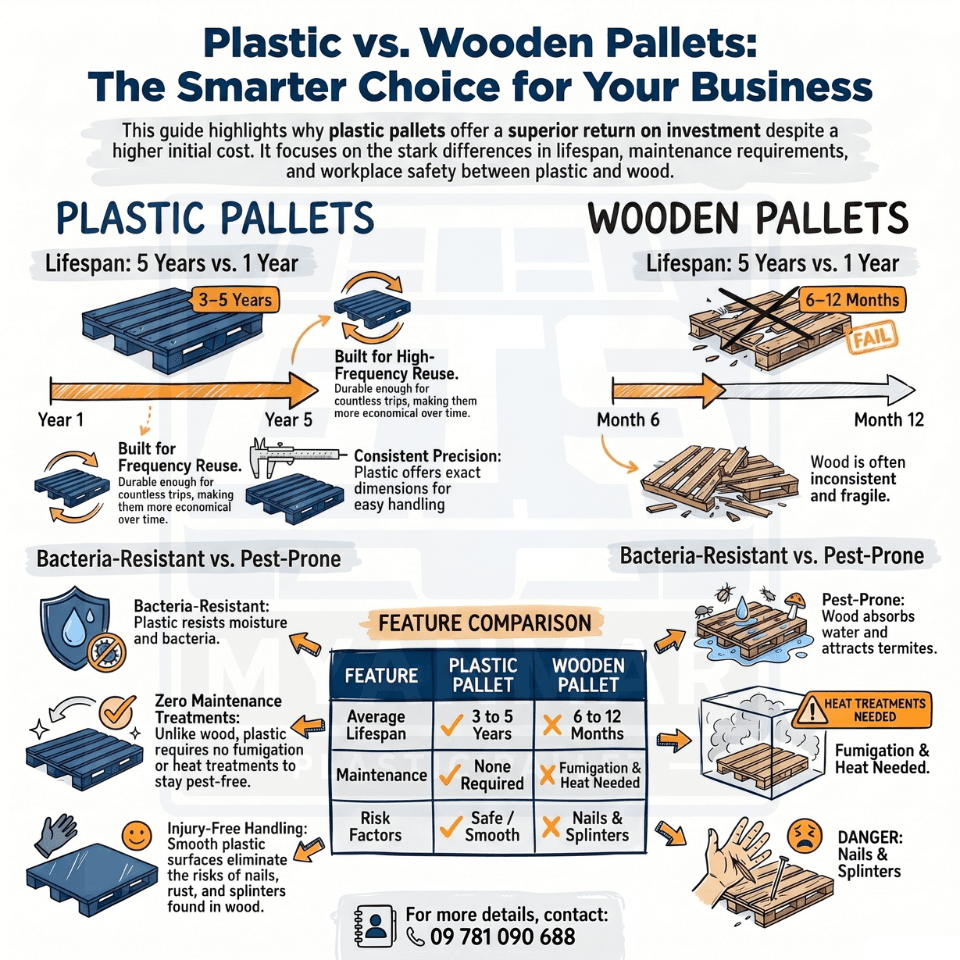
Choosing between plastic and wooden pallets is one of the most consequential decisions a warehouse operator makes. Both types carry goods, but they perform very differently across the criteria that matter most: total cost, durability, hygiene, and worker safety. Here is a direct comparison across four dimensions.
Economic Performance
Plastic Pallets
- Service life of 3 to 5 years under standard conditions; up to 10 years with proper handling.
- Higher upfront cost, but cost-per-use is significantly lower over the full lifecycle.
- Can be used hundreds of times before replacement.
Wooden Pallets
- Service life of 6 months to 1 year before degradation forces replacement.
- Lower purchase price, but recurring replacement cost accumulates quickly.
- Limited number of uses before structural failure.
Operational Performance
Plastic Pallets
- Consistent, precise dimensions that work reliably with automated equipment and racking systems.
- High structural rigidity; does not warp, split, or flex under load.
- Protects cargo from snagging damage caused by splinters or protruding nails.
- Lighter weight per unit makes handling more efficient.
Wooden Pallets
- Dimensions vary between batches — inconsistency causes problems with conveyor systems and automated picking.
- Susceptible to warping, splitting, and nail loosening over time.
- Exposed nails and splinters create cargo snag risks and workplace injury hazards.
- Heavier than equivalent-capacity plastic pallets.
Hygiene and Safety
Plastic Pallets
- Non-porous surface does not absorb water — no bacterial or mold growth.
- Insect and rodent resistant; no fumigation required.
- Smooth surface: no splinters, no exposed nails, no sharp edges.
- Approved for food-grade and pharmaceutical logistics applications.
Wooden Pallets
- Absorb moisture readily, creating conditions for bacterial and mold growth.
- Susceptible to insect infestation (termites, ants); fumigation is required for many export markets.
- Splinters and nails create workplace injury risks and cargo contamination risks.
Other Considerations
Plastic Pallets
- Available in consistent colors for visual identification and inventory management.
- Chemical-resistant surface that can be hosed clean.
- Recyclable at end of service life.
Wooden Pallets
- Variable appearance; no color standardization.
- Absorbs spills and chemicals; difficult to fully decontaminate once soaked.
For Myanmar warehouses and logistics operators focused on long-term efficiency, hygiene compliance, and total cost control, plastic pallets consistently deliver better value across every comparison dimension.